

 Image 1 of 1
Rene Cartoons Sticker (Game Time)
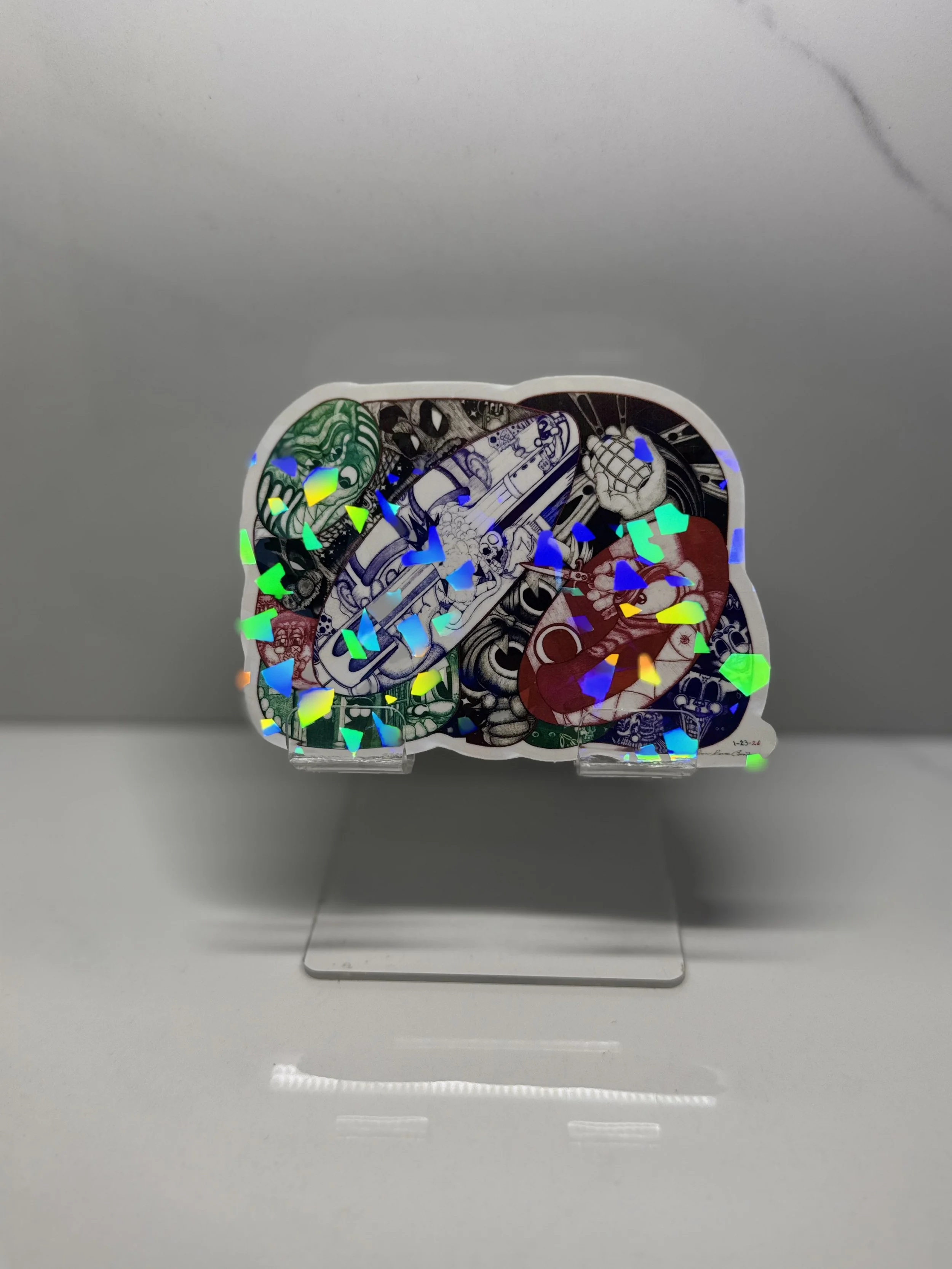
Game Time was conceived to fuse the raw brutality of the real world with the timeless aesthetics of classic cartoon cinema, unfolding as a cascade of simultaneous events across the Rene Cartoons universe — the Cartooniverse. The featured illustration presents four antagonists: a solitary figure clad in green and three counterparts in red, each poised to play a distinct role in the unfolding drama.
In the far left, drawn in blistering scarlet, stand Clownface and Pigsley — a duo whose twisted mirth and brutish loyalty mark them as the wildfire at the city’s edge. To their right, a new antagonist ascends the frame: Demon “The Devil” Doberman, a sleek predator whose cold glare fixes on the last figure in the composition. He toys with a butterfly knife, its blade catching the light like a promise, every movement measured and lethal.
Above them, in a sickly green hue, looms Bernard “Burn” Bear. Once Doberman’s ally in a ruthless climb through Toon City’s shadowed underbelly, Burn now occupies the opposite pole of their violent schism. The two men — one canine and precise, the other ursine and incendiary — were forged by ambition and separated by the city’s scarcity of power. Where once their partnership sought supremacy, their rivalry now dictates the balance of the streets: a collision of style and savagery played out across alleys and neon-lit facades, each poised to claim the throne of the City of Toon.
In the lower-left corner, in green, Malo Tav stands in a cell beside another inmate called Bon Bon. Aware of the danger that threatens them, they plot an escape — a measured maneuver born of necessity and ingenuity — to leave confinement and return, more determined, to restore the balance between good and evil.
The scene should breathe contained tension: economical gestures, exchanged glances and hushed voices, the outline of an improvised device — a discreet wire, scavenged fragments, a torn-down calendar serving as a silent accomplice. Muted lighting casts angular shadows, emphasizing the gravity of the moment and the stoic resolve of the two characters. The green that envelops Malo Tav suggests a calm, resolute strength, while Bon Bon’s proximity underscores the loyalty and complicity essential to their salvation.
The whole presents with a sober, controlled aesthetic: clear composition, precise graphic lines, a limited palette that heightens the dramatic intensity. Every visual element tells the story of their silent preparation — a fragment of conversation, a glance at the lock, a held breath — before the narrative shifts toward action, promising a measured struggle to restore the harmony of the forces at play.
In the left-center of the composition, rendered in cool blues, an event unfolds that would irrevocably alter the city of Toon. For the first time, a cartoon weapon — long dismissed as a gag and incapable of true harm — is employed with lethal intent. From the revolver emerges a bullet anthropomorphized with a mask, its expression almost playful as it bids the shooter farewell, certain that the shooter will not escape this exchange.
The scene’s tragedy is confirmed as a second bullet, cloaked in a skull mask and a dark hoodie, arcs toward the shooter, poised to draw a weapon from concealment and deliver the fatal stroke. In the background, a boy — an innocent bystander who, in another moment, might have been a hero — lunges to intervene, but the moment has already passed. The composition captures the sudden, surreal violence of a world where the rules of cartoon physics have been broken and mortality has been introduced with devastating consequence.
The blue masks in the lower right symbolize the corrupting vices of humanity that have infiltrated the creative process, undermining the spirit of the traditional cartoon and giving rise to monstrous new figures—such as Stabby the Clown, who stands among them.
To their left stands a skeletal figure shadowed in green—Death: a complex, principled philosopher whose ethical rigor belies his grim visage. Behind him, a constellation of eyes hovers in the background—each one a silent witness, preserving a moment of passing as an indelible image burned into memory. The composition evokes the paradox of mortality: a disciplined arbiter of endings framed by the unblinking testimony of those who survive them.
In the upper-left corner a moon hangs with a soft, eerie glow, its pale light spilling across a star-flecked night sky. Below, a stand of trees rises—gnarled and shadowed, their silhouettes balancing menace and mischief. Their twisted branches seem to leer and beckon at once, promising a spine-tingling welcome to any visitor daring enough to pass.
Among the trees, two wise bats keep watch. Calm and knowing, they perch like guardians of the wood, their keen eyes reflecting moonlight as if cataloguing every rustle and footfall. Together the moon, the playfully sinister trees, and the sagacious bats create a scene that is at once haunting and enchanting—an image of nocturnal mystery that feels both artistically composed and emotionally vivid.
The composition on the right shows Little Wolf in black, holding a grenade with the tense posture of someone about to throw it toward the viewer. He is a force to be reckoned with — young, proud, and harboring a latent resentment; ready to burst into action at any moment if anyone dares to challenge him.
Game Time was conceived to fuse the raw brutality of the real world with the timeless aesthetics of classic cartoon cinema, unfolding as a cascade of simultaneous events across the Rene Cartoons universe — the Cartooniverse. The featured illustration presents four antagonists: a solitary figure clad in green and three counterparts in red, each poised to play a distinct role in the unfolding drama.
In the far left, drawn in blistering scarlet, stand Clownface and Pigsley — a duo whose twisted mirth and brutish loyalty mark them as the wildfire at the city’s edge. To their right, a new antagonist ascends the frame: Demon “The Devil” Doberman, a sleek predator whose cold glare fixes on the last figure in the composition. He toys with a butterfly knife, its blade catching the light like a promise, every movement measured and lethal.
Above them, in a sickly green hue, looms Bernard “Burn” Bear. Once Doberman’s ally in a ruthless climb through Toon City’s shadowed underbelly, Burn now occupies the opposite pole of their violent schism. The two men — one canine and precise, the other ursine and incendiary — were forged by ambition and separated by the city’s scarcity of power. Where once their partnership sought supremacy, their rivalry now dictates the balance of the streets: a collision of style and savagery played out across alleys and neon-lit facades, each poised to claim the throne of the City of Toon.
In the lower-left corner, in green, Malo Tav stands in a cell beside another inmate called Bon Bon. Aware of the danger that threatens them, they plot an escape — a measured maneuver born of necessity and ingenuity — to leave confinement and return, more determined, to restore the balance between good and evil.
The scene should breathe contained tension: economical gestures, exchanged glances and hushed voices, the outline of an improvised device — a discreet wire, scavenged fragments, a torn-down calendar serving as a silent accomplice. Muted lighting casts angular shadows, emphasizing the gravity of the moment and the stoic resolve of the two characters. The green that envelops Malo Tav suggests a calm, resolute strength, while Bon Bon’s proximity underscores the loyalty and complicity essential to their salvation.
The whole presents with a sober, controlled aesthetic: clear composition, precise graphic lines, a limited palette that heightens the dramatic intensity. Every visual element tells the story of their silent preparation — a fragment of conversation, a glance at the lock, a held breath — before the narrative shifts toward action, promising a measured struggle to restore the harmony of the forces at play.
In the left-center of the composition, rendered in cool blues, an event unfolds that would irrevocably alter the city of Toon. For the first time, a cartoon weapon — long dismissed as a gag and incapable of true harm — is employed with lethal intent. From the revolver emerges a bullet anthropomorphized with a mask, its expression almost playful as it bids the shooter farewell, certain that the shooter will not escape this exchange.
The scene’s tragedy is confirmed as a second bullet, cloaked in a skull mask and a dark hoodie, arcs toward the shooter, poised to draw a weapon from concealment and deliver the fatal stroke. In the background, a boy — an innocent bystander who, in another moment, might have been a hero — lunges to intervene, but the moment has already passed. The composition captures the sudden, surreal violence of a world where the rules of cartoon physics have been broken and mortality has been introduced with devastating consequence.
The blue masks in the lower right symbolize the corrupting vices of humanity that have infiltrated the creative process, undermining the spirit of the traditional cartoon and giving rise to monstrous new figures—such as Stabby the Clown, who stands among them.
To their left stands a skeletal figure shadowed in green—Death: a complex, principled philosopher whose ethical rigor belies his grim visage. Behind him, a constellation of eyes hovers in the background—each one a silent witness, preserving a moment of passing as an indelible image burned into memory. The composition evokes the paradox of mortality: a disciplined arbiter of endings framed by the unblinking testimony of those who survive them.
In the upper-left corner a moon hangs with a soft, eerie glow, its pale light spilling across a star-flecked night sky. Below, a stand of trees rises—gnarled and shadowed, their silhouettes balancing menace and mischief. Their twisted branches seem to leer and beckon at once, promising a spine-tingling welcome to any visitor daring enough to pass.
Among the trees, two wise bats keep watch. Calm and knowing, they perch like guardians of the wood, their keen eyes reflecting moonlight as if cataloguing every rustle and footfall. Together the moon, the playfully sinister trees, and the sagacious bats create a scene that is at once haunting and enchanting—an image of nocturnal mystery that feels both artistically composed and emotionally vivid.
The composition on the right shows Little Wolf in black, holding a grenade with the tense posture of someone about to throw it toward the viewer. He is a force to be reckoned with — young, proud, and harboring a latent resentment; ready to burst into action at any moment if anyone dares to challenge him.